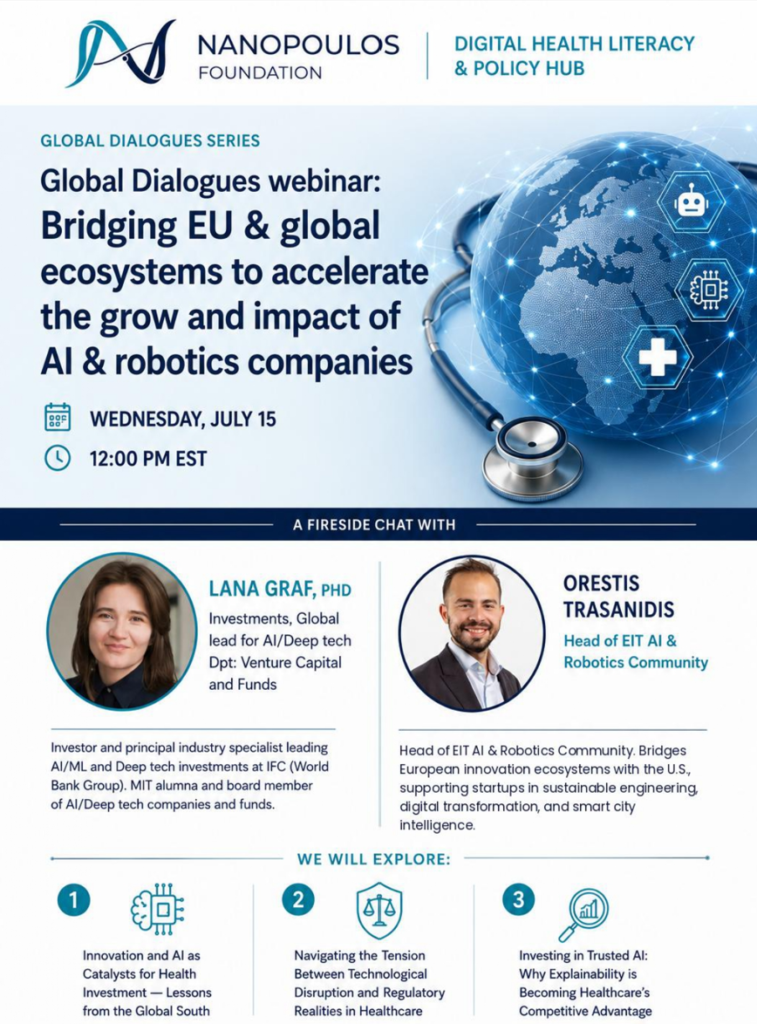
Wednesday, 15 July 2026
Speakers

Lana Graf, PhD
Investments, Global Lead for AI/DEEP tech Dpt: Venture Capital and Funds

Orestis Trasanidis, Head of EIT AI & Robotics Community
Manging Director, EIT Hub Silicon Valley
The July 15th webinar of the AI Health Literacy Hub’s Global Dialogues series explored how collaboration between European and global innovation ecosystems can accelerate the responsible growth of AI and robotics solutions, particularly in healthcare.
Through a dynamic fireside conversation, Lana Graf and Orestis Trasanidis examined the realities of AI adoption beyond the technology headlines, highlighting investment trends, regulatory challenges, digital literacy gaps, and emerging innovations from the Global South. At the heart of the discussion was a compelling proposition: the future of impactful AI innovation may not emerge primarily from traditional technology hubs, but increasingly from resource-constrained environments where necessity drives practical and scalable solutions. While much public attention remains focused on well-established innovation centers such as Silicon Valley, Boston, Berlin, and Paris, the speakers pointed to a growing body of evidence demonstrating that some of the most transformative AI applications are emerging from developing economies. This shift reflects a broader evolution in the AI landscape. Rather than simply replicating models developed elsewhere, innovators in emerging markets are building solutions specifically designed to operate under limitations in connectivity, infrastructure, workforce capacity, and access to specialized care. These constraints, paradoxically, are creating conditions for highly practical innovation.
A recurring theme throughout the conversation was the concept of “leapfrogging.” For years, digital development practitioners have discussed how developing countries could bypass traditional stages of technological development. According to Graf, AI is now beginning to make this vision a reality. She highlighted examples from Nigeria, where healthcare facilities are deploying AI-powered tools that operate entirely offline, enabling clinical decision support and patient triage in environments where internet connectivity remains unreliable.
The discussion underscored that AI’s value in healthcare is not necessarily derived from replacing human professionals but from augmenting their capacity. In contexts where physician-to-patient ratios are dramatically below recommended standards, AI can help reduce administrative burdens, improve diagnostic accuracy, and support frontline healthcare workers in delivering care more efficiently. Examples included speech-to-text systems that automatically generate clinical records during consultations, allowing healthcare providers to focus more fully on patient interactions rather than documentation.
Importantly, the speakers cautioned against viewing AI solely through a technological lens. According to Graf, one of the most significant lessons emerging from recent global discussions, including the AI for Good Summit in Geneva, is that human readiness may be a greater challenge than technological readiness. While AI tools are advancing rapidly, many individuals, institutions, and communities still lack the digital literacy necessary to effectively utilize them. This observation led to a broader discussion on skills development and digital inclusion. The conversation emphasized that successful AI adoption requires more than technical infrastructure. It requires investments in people, including healthcare workers, patients, educators, policymakers, and communities. Digital literacy was framed not as a luxury but as a foundational requirement for ensuring equitable access to emerging technologies.
Several examples illustrated how community-based approaches can accelerate this process. The speakers highlighted Rwanda’s successful Digital Ambassador Program, which has trained millions of citizens through locally embedded ambassadors who serve as trusted guides for digital uptake and skills development. Such models demonstrate that technology adoption is often driven less by the sophistication of the technology itself and more by the strength of the surrounding social and educational ecosystem.
The webinar also explored the relationship between innovation and regulation. While both speakers acknowledged the importance of governance frameworks such as the European Union AI Act, they emphasized that regulation must enable rather than stifle innovation. The challenge for policymakers is balancing risk mitigation with the flexibility needed for experimentation and deployment.
A key insight from the discussion was that regulation will almost always lag technological progress. Rather than attempting to predict every future development, governance systems should focus on establishing principles, guardrails, and mechanisms for ongoing adaptation. This approach allows innovators to build and deploy solutions while maintaining accountability for safety, transparency, and ethical use.
Closely linked to regulation was the theme of trust. Participants repeatedly returned to the idea that trust is not simply a matter of privacy or compliance but also of reliability and usability. Healthcare workers and patients must trust that AI systems will function consistently, generate useful outcomes, and address real-world challenges. In many settings, the practical reliability of technology may be just as important as formal governance frameworks.
The conversation further challenged common narratives surrounding AI and employment. While concerns about job displacement remain widespread, Graf argued that current evidence points more convincingly toward productivity enhancement than workforce replacement. AI is increasingly helping professionals perform tasks more effectively, enabling expansion of services and freeing skilled workers to focus on higher-value activities requiring human judgment, empathy, and expertise.
Perhaps the most important insight emerging from the session was that innovation is no longer flowing in a single direction. For decades, the dominant narrative positioned advanced economies as exporters of innovation and developing countries as adopters. The examples discussed throughout the webinar suggest a more interconnected reality. Solutions developed in resource-constrained environments are increasingly generating lessons that can inform healthcare delivery, digital inclusion, and AI deployment globally.
The dialogue concluded with a reflection on the importance of cross-regional learning. The speakers emphasized that Europe, North America, Africa, Asia, and other regions each bring unique strengths, experiences, and perspectives to the AI ecosystem. Sustainable progress will depend not on competition between these systems but on greater collaboration, knowledge exchange, and mutual learning.
Ultimately, the session reinforced a broader message that aligns closely with the mission of the Global Dialogues series: the future of AI in health will be shaped not only by algorithms and infrastructure, but by partnerships, literacy, trust, and the willingness of diverse ecosystems to learn from one another. As AI continues to transform healthcare and other sectors, meaningful impact will depend on ensuring that innovation remains inclusive, context-sensitive, and grounded in real-world needs.