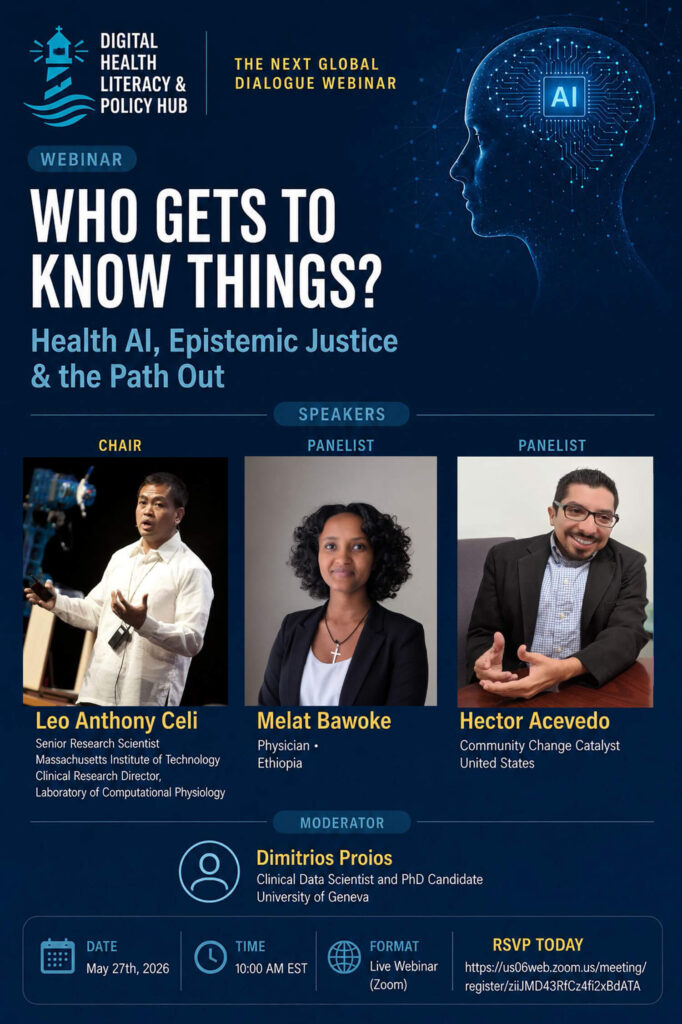
Wednesday, May 27, 2026
Chair:
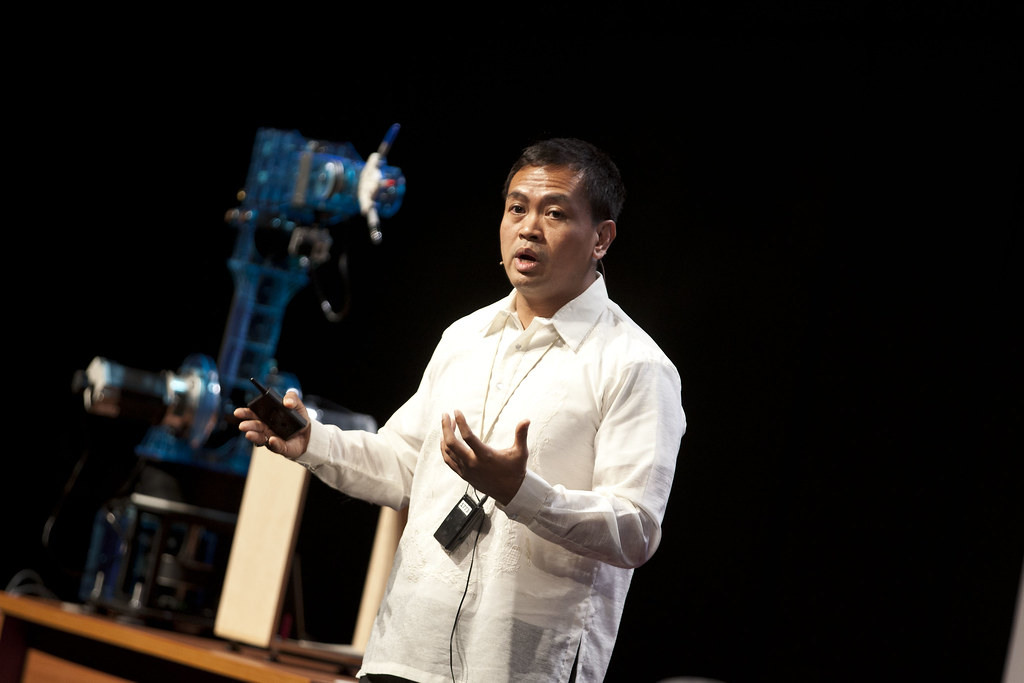
Leo Anthony Celi, Senior Research Scientist, MIT | Clinical Research Director, Laboratory of Computational Physiology
🎙️ Panelists

Melat Bawoke, Physician, Ethiopia

Hector Acevedo, Community Change Catalyst, United States
Moderator

Three continents. Radically different contexts. One urgent question: what must we unlearn for AI to genuinely improve lives — rather than mask deeper systemic failures?
💬 Expect an honest, thought-provoking discussion on:
- What we need to unlearn to work effectively with AI
- Whose knowledge is embedded—and excluded—in AI systems
- Whether AI is amplifying existing inequities rather than solving them
- And ultimately: are we brave enough to question the system itself?
This is not a conversation about tools.
It’s a conversation about mindset, systems, and the future of health itself.
Post-Event Brief
AI, Health & Epistemic Justice: The Path Out
The latest Global Dialogue webinar opened not with answers, but with a challenge: in a world where artificial intelligence is rapidly reshaping healthcare, the most urgent question is no longer what the technology can do, but who gets to decide what it should do, and whose knowledge it ultimately serves.
Bringing together voices from Ethiopia, the United States, and Europe, the conversation unfolded as a candid reflection on the deeper systems that underpin AI in health, systems of knowledge production, trust, and power. From the outset, it was clear this was not a technical discussion in the conventional sense. Instead, it became a reckoning with how historical inequities risk being reproduced, and amplified, through emerging technologies.
For Melat Bawoke, a clinician working in Ethiopia, the conversation was grounded in lived reality. She described a healthcare system shaped by medical education and research rooted largely in Western contexts, where diseases, tools, and assumptions often do not align with local needs. The consequence, she explained, is not merely inefficiency but a persistent gap between what is taught, what is built, and what is needed in practice. As AI begins to enter these systems, there is a growing concern that it may reinforce the same disconnect, scaling tools that were never designed with local epidemiology, infrastructure, or care pathways in mind.
Yet the discussion did not stop at identifying gaps. It reframed the problem entirely: what if the issue is not simply missing data, but whose data, and whose knowledge, counts in the first place?
Hector Acevedo brought this question into sharp focus by shifting attention to communities themselves. Drawing from his work in the United States, he challenged the implicit hierarchy that often places institutional data above lived experience. Community knowledge, he argued, is too often dismissed as anecdotal, when in reality it represents a form of evidence, one that captures barriers, behaviors, and realities that formal systems frequently overlook.
In healthcare settings, communities often understand the root causes of inequities long before institutions are willing to acknowledge them. The issue is rarely a lack of insight or engagement; it is a lack of trust. And trust, as the discussion repeatedly emphasized, cannot be built through consultation alone. It requires a fundamental shift toward power-sharing, where communities are not simply sources of data, but co-creators of knowledge, governance, and solutions.
This thread of power and its distribution ran consistently through the dialogue. Leo Anthony Celi expanded on this by turning attention to the infrastructure behind AI itself: data. While the push for data-driven innovation continues to accelerate, the reality remains fragmented. In some parts of the world, data is concentrated but siloed; in others, it is not collected at all. Without broad, equitable data ecosystems, he argued, even the most advanced models risk being fundamentally flawed.
But the issue is not only access to data, it is understanding it. Celi cautioned against the tendency to treat data as neutral or complete, noting that clinical datasets often erase the very context that shapes health outcomes. The reasons behind a missed diagnosis, a treatment failure, or a patient’s trajectory frequently lie outside what is captured in structured records embedded instead in social, economic, and environmental conditions. In this sense, the limitations of current datasets are not just technical, they reflect deeper blind spots in how health systems define knowledge itself.
Across the dialogue, a recurring tension emerged: the drive to build solutions versus the need to better understand problems. In an era of rapid innovation, there is a growing tendency to prioritize speed and scale. Yet, as highlighted in the discussion, this approach risks embedding shallow assumptions into systems that are difficult to undo. True progress, panelists suggested, requires a shift in mindset from solution-driven thinking to collective inquiry, grounded in diverse perspectives and real-world experience.
This shift also calls into question how AI should function within healthcare systems. Rather than replacing human judgment, participants emphasized the importance of supporting and augmenting frontline workers, particularly in resource-constrained settings. In Ethiopia, for example, opportunities exist to use AI to address specific, identified challenges, such as the lack of mentorship and knowledge-sharing platforms for community health workers. When designed around actual needs, AI can strengthen systems; when imposed without context, it risks becoming redundant or even harmful.
Equally, the conversation underscored that inclusion must be built deliberately into every layer of AI development. Language access, cultural context, gender representation, and trust are not peripheral considerations, they are foundational. Without multilingual access, for instance, entire populations are effectively excluded from participation. Without intentional inclusion of women and underrepresented groups in both data and decision-making, AI systems risk perpetuating longstanding biases in healthcare delivery.
By the close of the session, what emerged was not a roadmap, but something more nuanced. The path forward is uncertain, and perhaps necessarily so. As one panelist reflected, the future cannot be navigated using the same structures that created the current system. It demands experimentation, humility, and a willingness to move beyond established pathways, to rethink not only technologies, but the assumptions and power dynamics that shape them.
If there was one unifying message across the discussion, it was this: the future of AI in health will not be determined by algorithms alone, but by the choices we make about inclusion, trust, and whose knowledge is allowed to shape the systems we build.
The Global Dialogue did not attempt to resolve these tensions. Instead, it created the conditions for something more important—a shared recognition that the future of health AI must be co-created, not imposed.