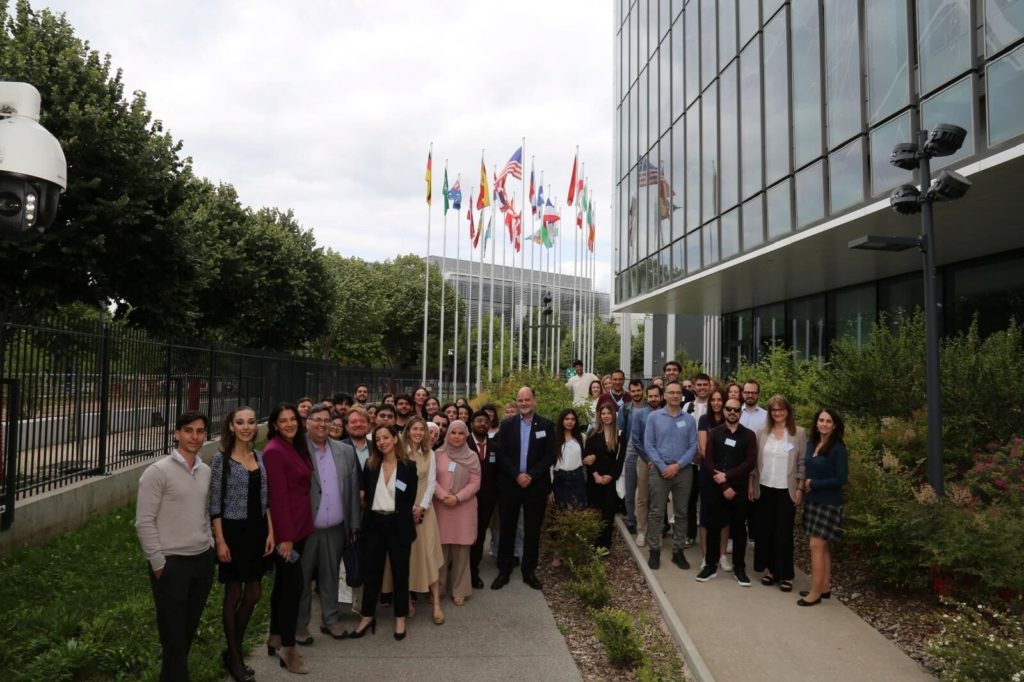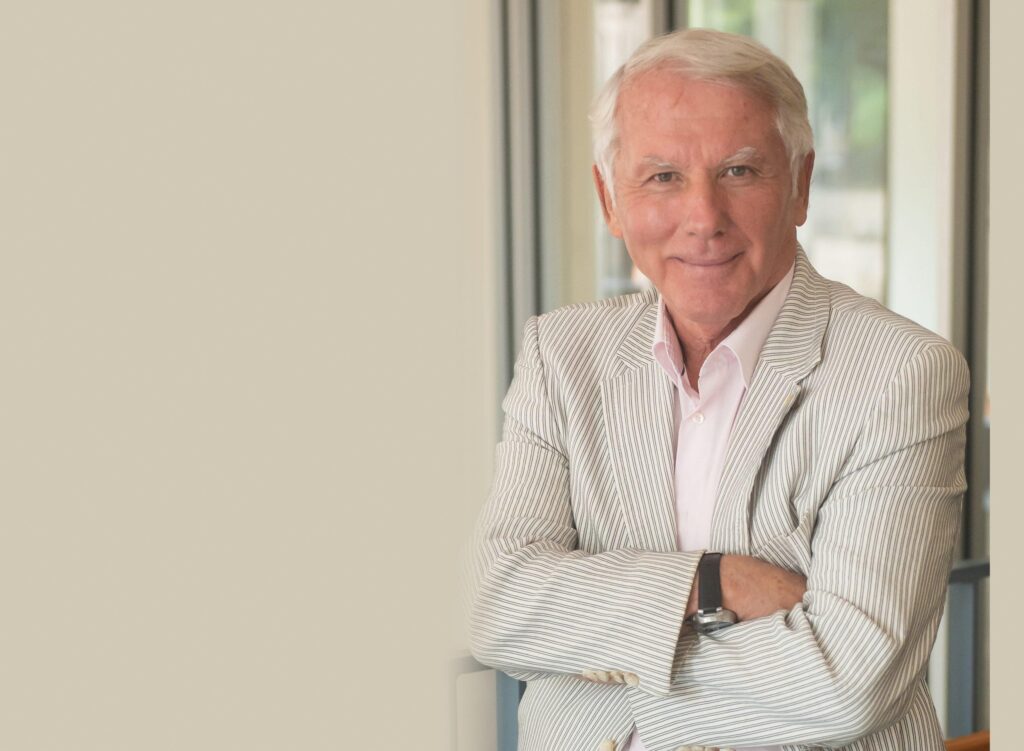
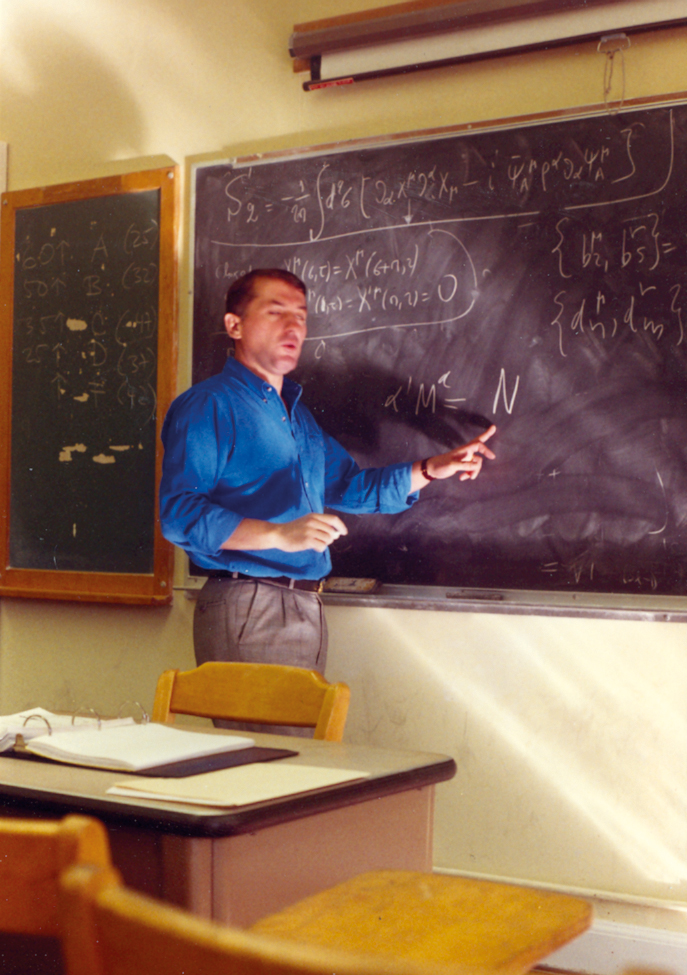
Dimitri Nanopoulos at Texas A&M University, USA, 2018.
By Yanna Katsageorgi | May 22, 2026
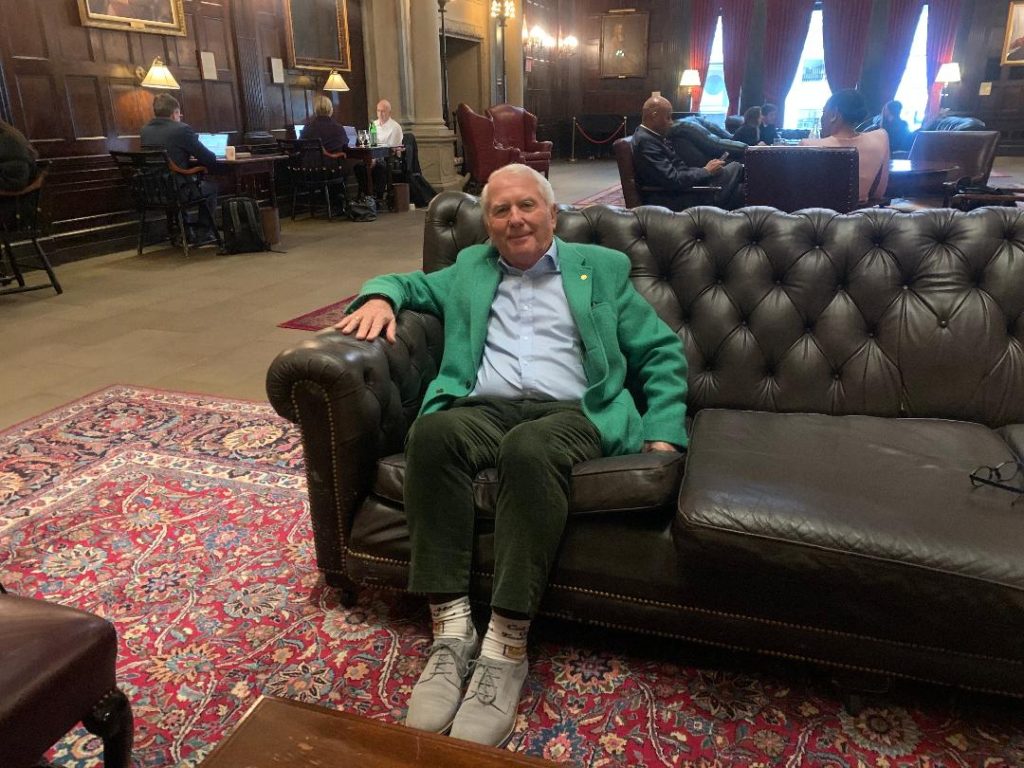
Most of the time, a destination gives away the nature of an encounter before it has even begun. It is almost as if it prepares you for what is about to unfold. But one afternoon around 5 p.m. at the Harvard Club in Manhattan, inside those drawing rooms that seem to have absorbed decades of conversations, power, and the masculine self-assurance of a Rooseveltian era, I found myself sitting across a man who, without the slightest effort, overturned every stereotype that space carried within it.
At first, we sat in two armchairs situated rather far apart, an arrangement that did not feel particularly comfortable, so we moved over to a deep, black leather sofa designed for “gentlemen”: solid, austere, almost imposing. It was he who made the first gesture to break this carefully staged atmosphere. Quietly, almost imperceptibly, he stood up, walked away, and then returned with some fresh squeezed orange juice and salted peanuts as though we were in a neighborhood café rather than in a place that makes you weigh every word before you say it.
It was in that moment that I began to experience the shock of the discrepancy between what I had expected and what was actually unfolding before me. That was because sitting across from me was not simply one of the world’s most distinguished theoretical physicists, whose journey has taken him through CERN, Harvard University, and Texas A&M University, but a man who strips away every sense of obligation or pretense, and who, within a single sentence, can dismantle every illusion of grandeur through his humanity, sincerity, and authenticity. The man I came to interview was Dimitri Nanopoulos.
Overwhelmed by fear that I might overstep or appear inadequate, I had come excessively prepared. Forty-seven questions, written on pages that became disordered from my nervous hands, as though they, too, wanted to escape the interview along with me. But that only lasted until he looked at me kindly and said something that liberated me: “Let’s do this more freely. The conversation becomes better that way.” And he was right because what followed was not a conventional interview. It was a conversation that began with May Day and the “post-human” condition and traveled all the way to the Big Bang, quantum randomness, and the idea that the universe owes us absolutely nothing.
The reason that brought him to New York, after thirty years of life in Houston, is the new division of his own Nanopoulos Foundation, the New York City-based Digital Health Literacy and Policy Hub, which promotes science education and seeks to bridge science, technology, and society.
Born in Pallini, Greece, he grew up with simplicity, in an environment that offered him something deeper than knowledge: a way of life. He may speak about multiverses, yet at the same time remind you that what truly matters is being able to look at yourself in the mirror and smile. Sitting beside him, I felt a warm, reassuring sense of wonder since behind the genius stood a man who never forgot how to remain human. Perhaps, in the end, it is that, that is the most “cosmic” lesson of all and the only way the world’s chaos can ever acquire meaning.
And one more thing before you read his interview. His surname derives from the ancient Greek word nanos (“dwarf”), a word that in modern physics has become associated with something extraordinarily vast: theories of the universe, mathematics, and infinity. Perhaps, after all, it is not unreasonable to think that the universe, in its own quiet way, chooses certain people through whom to express itself — not in any mystical sense, but as a poetic, coincidental meeting between chance and necessity.
The National Herald: Mr. Nanopoulos, in an era where science and technology are reshaping the world, what remains of great commemorations and struggles such as May Day? Are they anchors of memory that will continue to define us, or traces of a world that is fading away?
Dimitri Nanopoulos: I would tell you that, before long, these things will become traces of the past. I would like to believe, however, that they will remain anchors, as you put it, or islets on which we can stand in order to move forward. As for revolution, whether in its literal or metaphorical sense, I do not think humanity will ever stop rebelling in one form or another. They may not possess the ferocity of the French or Russian Revolutions that changed the course of history, but I believe that, given the direction in which humanity is now heading, the human being will not remain the same species. I hope that we never reach the point where we also look back at the past and say, this is what we once were.
TNH: Do you believe that the rapid developments in technology, biology, and artificial intelligence are leading to the creation of a different kind of human being?
DN: We are transitioning to what I call the “post-human.” Humanity will change — in fact, we have already begun to change. We cannot fully grasp, through the ideas we currently possess, that we will become profoundly different. These changes will not simply be a continuation of history; they will be an abyss. Whoever lives to witness it will understand…
If you ask me in a detached and rational way, I would say that because not everyone perceives what is happening in our era in the same way, I fear that, at least initially, there may be turbulence, since people are afraid of change. If I look at it from a more long-term perspective, however, I imagine humanity will eventually adapt and learn to use these developments wisely.
There are, of course, some people who actively participate in these transformations, but they are very few. So, in conclusion, many concepts and values as we know them today will continue to fade away. Yet they will be replaced by different kinds of “islets” — new frameworks capable of satisfying the abilities and the minds of the post-human.
TNH: If we look at the past, how did humanity manage to achieve such extraordinary accomplishments without the tools we have today? Could there have been some kind of external assistance, or can everything be explained through human evolution itself?
DN: I find it hard to imagine that in a 13.8 billion-year-old universe, containing roughly 100 billion galaxies with each galaxy holding another hundred billion stars and with continuous discoveries of stars similar to our sun over the past thirty years, that there would be no life elsewhere. I am agnostic on these matters. It is far more likely that forms of life do exist rather than not. Of course, they would probably be vastly different from us; they may not even possess anything resembling our DNA.
At the same time, however, there have truly been periods in history when human beings displayed extraordinary intelligence. Archimedes, Pythagoras, Democritus — if you consider what they proposed in comparison to what we know today, it is astonishing. Many of the ideas they put forward were only proven correct two thousand years later. So there have always been individuals who were extraordinarily advanced for their time.
TNH: The three ancient Greek philosophers and mathematicians you mentioned did not speak about the universe in the same way, yet all of them contributed to its physical and mathematical understanding. So, what language does the universe ultimately speak, and what does it mean to you personally?
DN: As Galileo said, “the book of nature is written in mathematics.” And what truly matters for us is that we have now reached a point where we understand, to a great extent, how the universe began. We have a fairly good picture of what we call the Big Bang and it appears that the universe is self-created.
I feel that this is my purpose. Ever since I was young, I was bored by the things we did in school and believed that great philosophical questions can only be answered through experimental data, and we continue to witness this constantly. The universe is a quantum fluctuation emerging from “nothingness” and it moves toward infinite time. It existed, it exists, and it will continue to exist. Like water that flows endlessly, a continuum of which we perceive only very small fragments.
TNH: What is remarkable about human beings is that they possess memory; that is why knowledge is never truly lost. Newton used to say that “we stand on the shoulders of giants,” referring to the great minds that came before us. Without Galileo and Newton, where would we be today?
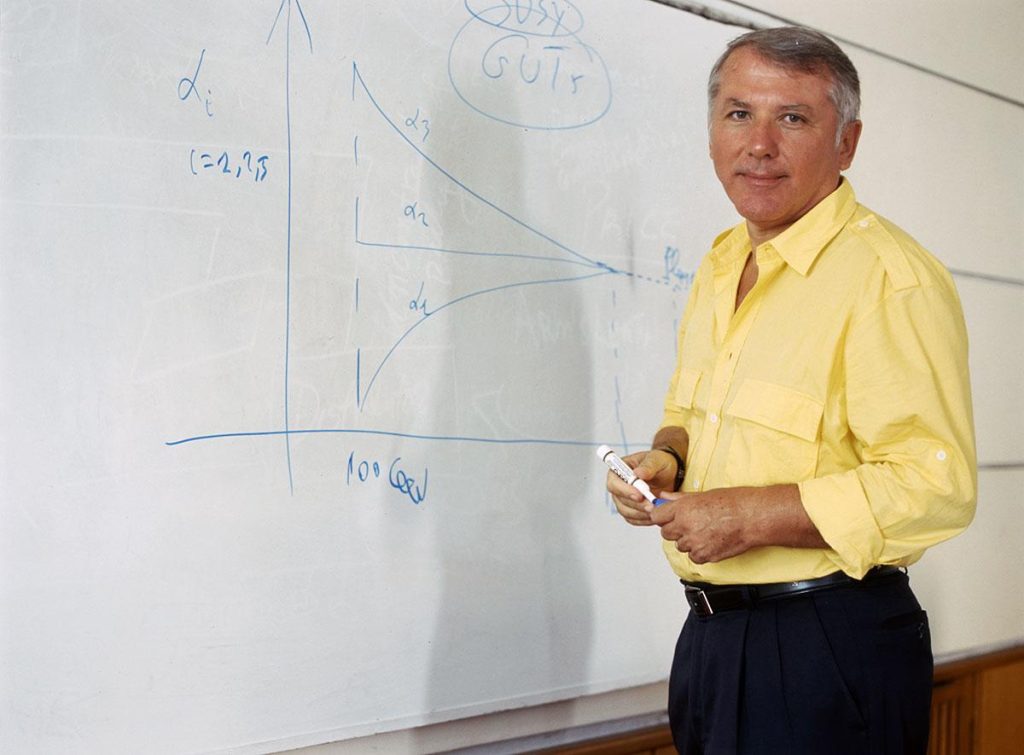
DN: Today, we are answering questions first posed by Thales, Democritus, and Heraclitus. For reasons I will not go into now, the works of Democritus and Heraclitus were lost. Yet Heraclitus had said: “This world was created neither by god nor by man; it always was, is, and always shall be.” And he said this in the 6th century BC! Modern theories of the multiverse are not all that different; they touch upon similar ideas which today we attempt to approach scientifically.
We must not forget that a theory may stand for three hundred years and then be overturned by a single experimental result. In our field — theoretical and experimental physics — we simply state what we discover. Others will not dictate to us what we are allowed to say. Many of the beliefs we hold today are going to change. The world has not yet fully realized this.
TNH: You once said during a lecture: “Be careful, be careful what you do in this life, because it may happen again.”
DN: Yes, there is this universe we are living in, governed by specific laws, but it is possible for the same universe to be recreated exactly as it is now. And if the initial conditions are close enough to the present ones, things may repeat themselves and we may find ourselves here once again, like what we call déjà vu.
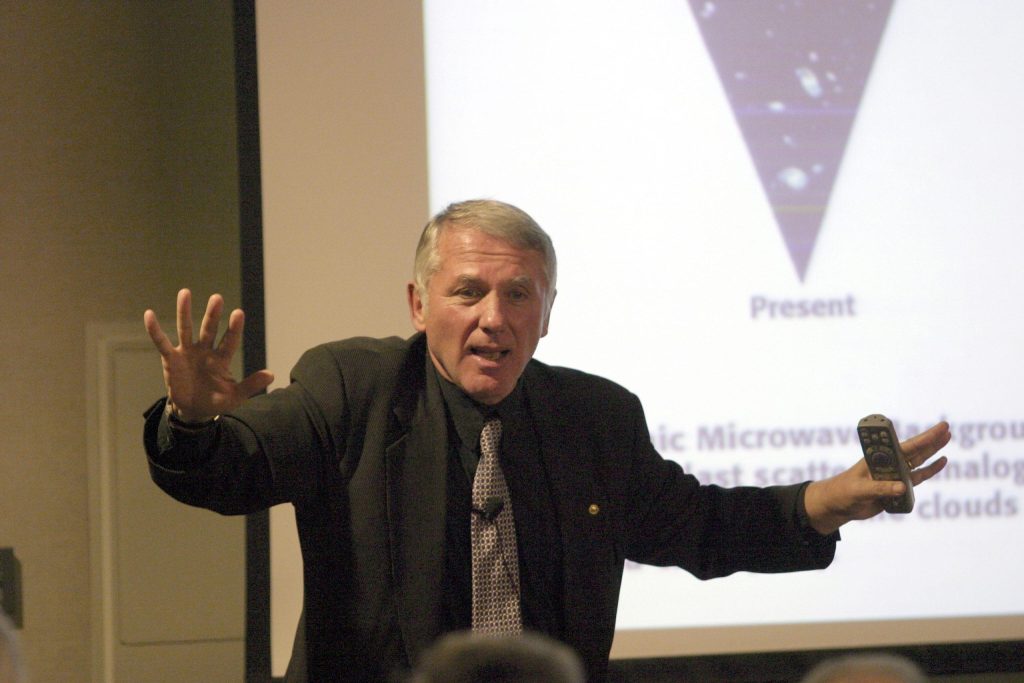
The steps we are taking now are extremely bold. There are strong reactions from certain people. It is not philosophy that provides answers to science. One day I was explaining that we only know 4% of the matter from which the universe is made of — protons, neutrons, and so on. Twenty-three percent is what we call dark matter, which we know exists but whose exact properties remain unknown, and 73% is dark energy. It is not only that we are not the center of the world — the universe has no center — but we are not even made from the substance that constitutes most of the universe.
TNH: Yet a part of us is. Does that also include our thoughts?
DN: Neuroscience today is very clear on this point: the brain is the “machine” of the mind. Thought emerges from it, memory exists, but all of these are generated through neural circuits. Marx used to say that quantitative accumulation brings about qualitative change, and this is precisely what happens here. People used to tell me: “Come on, Dimitri, you mean to say that by putting together ten neurons you will create thought?” But it is not ten neurons, it is roughly one hundred billion. And they are not all responsible for the same thing, rather, they form vast networks that lead to what we call thought, and the sum of all these processes is what we call consciousness. Consciousness is the totality of the interactions taking place in the brain at any given moment.
TNH: What happens when we die? Does consciousness remain, or does it come to an end?
DN: When we die, everything simply disintegrates. We reach the end. The answer here is stronger and more firmly grounded. We become matter once again — protons and neutrons, as we say. Even the Gospel says it: “Dust we are, and to dust we us shall return.” From that point onward, our personal story comes to an end.
Heraclitus also believed this. At the beginning, I mentioned that the writings of Heraclitus were lost. That happened because the teachings of Plato and Socrates were more compatible with other dominant ideas of the time, and so those traditions survived. As for Democritus, it has been written that Aristotle and Plato were not favorable toward him, because his ideas challenged their own.
TNH: There are theories, such as the “Law of Attraction,” which claim that our thoughts influence the universe and that positivity brings results.
DN: I will put it simply: I believe that when you are constantly negative, or when your mind is not functioning clearly, you are more likely to make mistakes. And afterward, some people interpret this as “negative energy.” This applies to everyone. Do you know how many mistakes I made when I was irritated or upset? Not toward others, but personally.
The ancient idea of nemesis following hubris is similar: people in positions of power are often carried away, lose their sense of measure, make mistakes, and ultimately face the consequences not because of some supernatural force, but because of their own actions. What we call “bad timing” or the idea that some people “attract negative energy” often has a much simpler explanation: when you lose control of yourself and behave foolishly, it is not the universe that is to blame, but your own self. Our fate is our character.
TNH: What role do luck and misfortune play in our lives? Do they truly exist?
DN: When I say that the universe is a quantum fluctuation, I mean that it contains randomness. The moment quantum physics, the physics of the microcosm, enters the picture you might say to me: “What are you talking about, Mr. Nanopoulos? We live in the macroscopic world.” Yes, but the universe is expanding, and in its beginning it was smaller than an atom, even smaller than an electron. Therefore, when it first emerged, it obeyed the laws of quantum physics, and consequently it contains randomness within it.
If randomness exists, then what is our purpose in life? Are we ourselves a random creation? If the universe is random, are we not also the result of that randomness? So who is right? Albert Camus said that the universe exists and we exist. The problem begins when we try to impose a purpose upon it, that is where what he called the “absurd” begins. That is why, in my new book, “The Quantum Myth of Sisyphus,”, I analyze the theory of the absurd by connecting it to quantum physics.
TNH: Does this randomness also give rise to diversity among people?
DN: Arthur Schopenhauer once said something extraordinary when he was asked what our purpose is: that the human being is essentially a means through which the species continues itself — a kind of “machine” of reproduction, and that through this process, geniuses, wise individuals, and artists occasionally emerge, illuminating the world.
That is why the people who move humanity forward are often “random” in a sense, and their success does not depend on whether they are rich or poor. One does not need to become a physicist or a biologist to understand these things. A basic understanding of logic and physics is enough. We are not talking about thirty-fifth-degree equations. We are talking about the way our thinking works and the attitude we take toward life. In any case, the people who push the world forward should be protected like “the apple of our eye,” not stoned and condemned.
TNH: Quantum physics is considered one of the great revolutionary achievements of science. In simple terms, what distinguishes it from classical physics?
DN: The principle of uncertainty. In classical physics, if you give me a particle, its velocity, and tell me that it begins from a certain point at a specific moment in time, I can determine its trajectory and tell you exactly where it will be whenever you ask me.
In the world of microphysics, however, this is no longer possible because of Heisenberg’s uncertainty principle, which tells us that it is impossible to determine both the position and the velocity of a particle at the same moment in time. Therefore, if I do not know the velocity precisely, I cannot determine exactly what will happen afterward. If you provide me with the velocity, I can tell you that there will still be a margin of error, and within that margin I can define a region in which the particle may move. This is where the concepts of randomness and probability enter the picture.
Quantum physics emerged in 1925, and we celebrated one hundred years since its birth in 2025, which the United Nations and UNESCO declared the “International Year of Quantum Science and Technology.”
The uncertainty principle has been proven beyond any doubt. There is no debate about it anymore. That is what we base our understanding on, that the universe itself is a quantum system. We just need to accept is.
TNH: Your scientific voice reaches ordinary people with a rare immediacy. You build relationships through your knowledge in a unique way. People are not intimidated by you.
DN: Thank you. I received a great deal of love from my parents, and I have always disliked artificial, rigid language. Perhaps that is the reason. The truth is that people have come to me and told me that, although they may disagree with what I say, they appreciate the way I say it.
I would like to raise another point here that is, in a sense, related to your question. In my public lectures, I have often been asked important questions by people without any formal scientific background, questions one would not expect, and they have, unknowingly, helped me think differently. Once, during a lecture in Houston, there was a woman in the audience who asked me some truly remarkable questions. I asked her if she was a scientist, and she replied: “No, I am a housewife.”
TNH: You are raising a very sensitive issue. There are brilliant young people, genuine geniuses, who are lost because they do not have the financial means, the right conditions, or the people to support them, and they end up growing into professions that are completely unrelated to their abilities.
DN: This is precisely why my wife, Olga, and I founded the Nanopoulos Foundation here in New York. When I left Greece, apart from my high school teacher, Vangelis Tsigounis, a physicist who showed me my first steps and set me on a path, I also had, at the university, Fokion Hadjioannou, a great theoretical physicist of international renown, from whom I learned the foundations of theoretical physics. All of us were created from him. How was I supposed to know theoretical physics? We learned everything at university. I was lucky, but how many young people were lost along the way!
That is why I want to help Greek youth with specific talents and abilities. In Greece, everyone tends to focus on the arts. I have nothing against the arts — I will not become Timothée Chalamet and have myself “pinned to the wall,” so to speak — but the funding directed toward the arts is large compared to that reserved for science. I am trying to identify children who lack the financial or social means and help them. We already have many such students, and the foundation is now becoming widely known.
We have a center in Greece called the Cosmo-Logos Research Center for Science and Culture, which aims to bring science and culture together. We will be organizing many events there. In addition, there is another initiative, inspired and realized by my wife, Olga Tzortzatos Nanopoulou, a lawyer specializing in bioethics, the Digital Health Literacy and Policy Hub in New York. It is a global initiative that brings together experts, young scientists, and professionals in health and technology to help people better understand digital health.
There has always been a serious problem: people often do not understand how healthcare systems function. It is tragic. This has never truly been addressed before. We aim to conduct studies to assess what people actually know across different countries, although the results so far are not encouraging. We also seek to promote the ethical use of artificial intelligence and data, and to shape policies that leave no one behind. I am very proud of these two initiatives, and that is precisely why we came to New York.
TNH: Having lived for so many years in Houston, how do you experience New York — as a change of place, or as an inner shift within yourself?
DN: In the 1950s, we were still in Harvati, Pallini. I was eight years old and would listen with a sense of awe to the radio every Thursday from 9:30 to 10:00 p.m. — which felt quite late for me at the time — to “The Adventures of John Greek,” a half-hour program about a famous Greek-American detective in New York. That stayed with me. It left a deep impression.
So when I first came to New York in 1977, I went to Park Avenue — to the Pan Am building overlooking Grand Central, and ever since then, even today when I go there, I still carry that same feeling I had as a child listening to that program and dreaming of New York. But I never expected that I would actually live here. I used to come very often and never missed an opportunity to visit, but I never imagined that I would have the chance to live here. I had been in Houston since 1989, and since June 2025 we have been living here.
TNH: If we turn for a moment to our homeland, Mr. Nanopoulos, are we talking about a missed opportunity or a path that is still unfolding?
DN: Greece has evolved, and it could not have done otherwise. We Greeks have this characteristic: we argue among ourselves, but we accept it as a given, we all try to make compromises, to “add water to the wine,” and move forward. We have the intellectual capacity, even on the average level. We have good qualities and we love life. It’s just that everyone is an expert on everything, “Come on now, you’re telling me?”
As for me, since I was a child I had a tendency to want to escape. Don’t ask me why, I don’t know. I was young and I didn’t fully understand. I wanted something more. I instinctively felt I was in a closed system; something didn’t feel right. As Savvopoulos used to say: “Something is not right in this city, and I’m running through the pharmacies.” Later, I became more conscious of it. If I had been a painter or a writer, perhaps I should have stayed, because that would have been an environment where I could have integrated. We produced Elytis, Hadjidakis, Seferis, Tsarouchis, and many others. But for what I wanted to do, there simply wasn’t a field of research.
Nevertheless, I must say I feel very proud to be Greek. I am glad I was born and raised in Greece during those years. But we should not forget that Greece has gone through a great deal. When I entered university, we were under a dictatorship. Then a major change came, and that “abscess,” as I would call it, was broken. We have had many ups and downs but we are moving forward. Still, we have paid and continue to pay a heavy price for our dilemma between Kolettis or Kapodistrias.
TNH: If you were given the opportunity to change certain things, what would you change in Greece?
DN: I do not like “little cliques.” Perhaps because from a young age I had the sense that my time is limited. I thought I would “leave” by 40; that idea was always in my mind and it became a strong driving force pushing me to act. I am very solitary, do not like wasting time, and I cannot tolerate small, cliquey groups of people.
I am not only referring to nepotism, but more broadly to the cliques that form, recycle themselves, and ultimately repeat the same patterns. It is well known that power corrupts. You see people take positions, leave, and then the same structures restart. Somewhere along the way, real renewal and meritocracy are lost.
I must declare here that I am a democratic person, without belonging under any “banner” or umbrella. And I believe that, even if slowly, there is a tendency toward improvement and meritocracy, through changes, collaborations, and reforms. What bothers me, however, is when someone sits across the Atlantic and throws accusations and lectures others; that is not good, because you are you are criticizing outside of the reality. Politics in general does not particularly move me, but I believe there are people capable of doing it properly. They may be few, but they exist.
TNH: You have devoted your life to science and physics. Does this understanding of fundamental laws bring you closer to the universe or make you realize how far you still are from it?
DN: If I had ten more lives, I would do the exact same thing. It brings me closer. At the beginning of my new book, which will be published in about a month, I start with a poem by Stephen Crane, “A Man Said to the Universe.” The key line is: “Sir, I exist!” and the universe replies: “The fact has not created in me a sense of obligation.”
In simple terms, we must free ourselves from the idea that the universe is involved in human affairs. The universe does not care about us, nor does it conspire against us.
TNH: Tell us about your new book, “The Quantum Myth of Sisyphus.”
DN: I have just completed a new book, which I have sent to Athens, titled “The Quantum Myth of Sisyphus,” inspired by Albert Camus, my most beloved intellectual. In it, I try to accomplish something that has rarely been attempted: to unite philosophy and quantum physics.
The book contains a great deal of physics, simplified, of course, but contemporary. When I tell you that the universe is a quantum fluctuation emerging from nothingness, that alone shows that Camus was right in his theory of the absurd. Camus gives you the opportunity to create your own meaning of life. He did not say, “despair because life has no meaning.” He said, accept the absurd, do not search for false answers, and continue to live and create. To create is to live twice.
This book is something that has never been done before in the world. It combines philosophy with physics and mathematics. I have provided what I would call a “scientific reinforcement” to demonstrate that Camus was right. It will be published in June and in United States as well. I wrote it entirely by hand; it is about 100 pages.
TNH: What do you want the reader to take away after closing this book?
DN: That we are free. We are “escapees” from the moment we are born. We escape the womb, we escape time, and we escape, as much as we can, our very own limits.
TNH: Finally, Mr. Nanopoulos, can science give meaning to life, or does it simply show us how “absurd” it is?
DN: The answer may lie in a paradoxical reconciliation. Instead of demanding that the universe give us meaning, we can accept uncertainty as a fundamental condition and create — not in spite of the absurd, but because of it.